
EnerPHit: Passive House for Existing Buildings

“Old doesn’t have to mean inefficient”
Most traditional UK renovations focus on aesthetics while leaving the underlying problems—drafts, cold spots, and hidden moisture—untouched. EnerPHit is the world’s most rigorous retrofit standard. We don't just 'improve' your home; we fundamentally transform its performance to provide library-level quiet and constant thermal comfort.
In 2022 the average home in the UK was rated as an EPC D, but HM Government’s target is for the average to be a C rating by 2035, and achieving net-zero by 2050.
With millions of existing properties up and down the nation all needing to be brought up to higher standards, each with its idiosyncrasies, a one-size-fits-all approach can lead to underwhelming results, wasted time and money, and damage being caused to the homes we all love.
Using the Passive House Institute’s (PHI) methods and Passive House Planning Package (PHPP), we can create a retrofit plan tailored to your property and it’s location to bring it up to world-class EnerPHit standards.
Why EnerPHit?
Thermal comfort isn’t the only reason to aim for the EnerPHit standard:
Acoustic Isolation: Thickened insulation and triple-glazed EnerPHit-certified windows don't just keep heat in—they keep the outside world out.
Health & Air Quality: Constant, filtered fresh air via MVHR means no more winter condensation, no pollen, and a significant reduction in indoor pollutants.
Zero-Draft Living: We eliminate the "convection currents" that make even expensive period homes feel chilly in February.
Don’t Guess. Model.
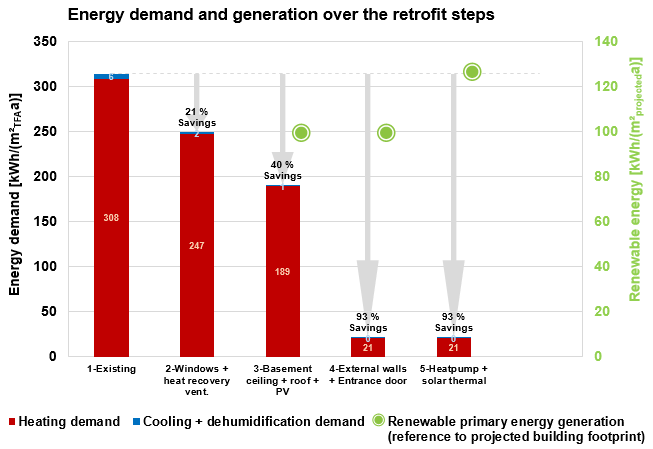
An EnerPHit project is a major investment. That’s why we start with a Step-by-Step Feasibility Study. We model your home’s current performance in PHPP and show you exactly which interventions—windows, wall insulation, or airtightness—will provide the greatest impact. Whether you do it all at once or over five years, you’ll have a master plan that ensures every pound spent is an investment in certainty.
"What about Planning & Conservation?" We specialise in navigating the tension between heritage requirements and modern performance.
"Do I have to move out?" Not always. A phased EnerPHit plan allows for strategic improvements during scheduled maintenance or room-by-room renovations.
The Feasibility Study: Your Risk-Mitigation Blueprint
An EnerPHit project is a significant investment in your property’s future. Jumping straight into construction without a PHPP model is the most expensive mistake you can make.
Our Feasibility Study provides:
A Digital Performance Twin: See exactly how your home performs before you spend a penny on builders.
Optimised ROI: We identify the "sweet spot" where insulation thickness meets cost-efficiency.
Sequencing Logic: A clear order of works to ensure no "double-handling" of costs.
Technical Security: Verification that your project will actually achieve the EnerPHit standard upon completion.
The Five Principles of EnerPHit
-
By sealing off even the tiniest of unintended draughts we can keep dust, pollution, unwanted moisture and bugs outside.
-
By integrating whisper-quiet mechanical ventilation, you’re provided with healthy, filtered fresh air 24/7. The heat recovery unit pulls the warmth from the stale air and pre-heats incoming fresh air.
-
Triple glazed windows with the right glass in the right place to create a safe, warm and serene environment.
Doors and windows are carefully specified to retain the character of your property, whilst also gaining the most free energy from the sun and keeping the noise out.
-
By carefully considering how your home is built, we can design-out cold spots caused by uninsulated junctions, keeping your spaces consistently warm.
-
Warm and comfortable buildings are a product of careful design and continuous insulation.
We can design your insulation to be internal and maintain your fascade, external to maximise floor space, or a combination of the two.
Space is precious, so we keep up to date on the latest in insulation technology in order to offer you space-saving insulation products for when you need every square inch.
Why Choose an EnerPHit Retrofit Plan?
Quality Assurance
In order to achieve the Passive House Institute’s ‘EnerPHit’ standard, projects are assessed both on paper and real-world results through testing. Certification gives you the peace of mind that your retrofit has been designed and built to the highest standards and will perform as expected.
Step-By-Step
We recognise that few people have the resources to implement an entire deep energy retrofit at once. The Enerphit Retrofit Plan (ERP) allows us to develop a long-term strategy for refurbishment. This reduces the chances of short-term measures that could lock in modest gains, and instead allows improvements that interlink and complement each other over time.
Conservation Area Friendly
Reducing the energy usage of your building doesn’t have to mean covering up architectural details with external insulation. Where required, internal wall insulation can be used to reduce energy losses while keeping the character of the property intact.
Measures That Pay For Themselves
As part of the PHPP EnerPHit process, we model your home as it is currently, as well as what it could be. By calculating the energy saved over years, we can prove how long it will take to cover the costs of renovation, including interest and inflation.
Of course, there’s also the unquantifiable advantage of living in a quiet, comfortable home with fresh filtered air.
Tailored to Your Location
Using the Passive House Planning Package (PHPP), we take into account your local climate data, elevation, shading from nearby trees and buildings, all to make sure the models and proposed work perfectly suit your situation.
First, Do No Harm
Older methods of construction require different approaches to renovation and insulation in order to avoid causing damage due to trapped moisture or interstitial condensation. We use analysis of the existing structure to tailor the retrofit approach to your home’s unique situation and make sure that any materials used won’t cause unintended consequences further down the line.
Enerphit Criteria
Space heating demand <25 kWh/(m²/a)
Space cooling demand <25 kWh/(m²/a)
Airtightness <1.0 n50 1/h
Non-renewable primary energy (PE) <120 kWh/(m²/a)